WavSniper
a sample librarian for producers
Snipe the perfect sample.
Producers lose their flow hunting through thousands of samples buried in nested folders and sample packs. WavSniper scans your whole library, auto-tags every sound, and makes any of them findable, auditionable and drag-ready in seconds.
v1.1.0 · Windows 64-bit · free 14-day trial, then $49 one-time
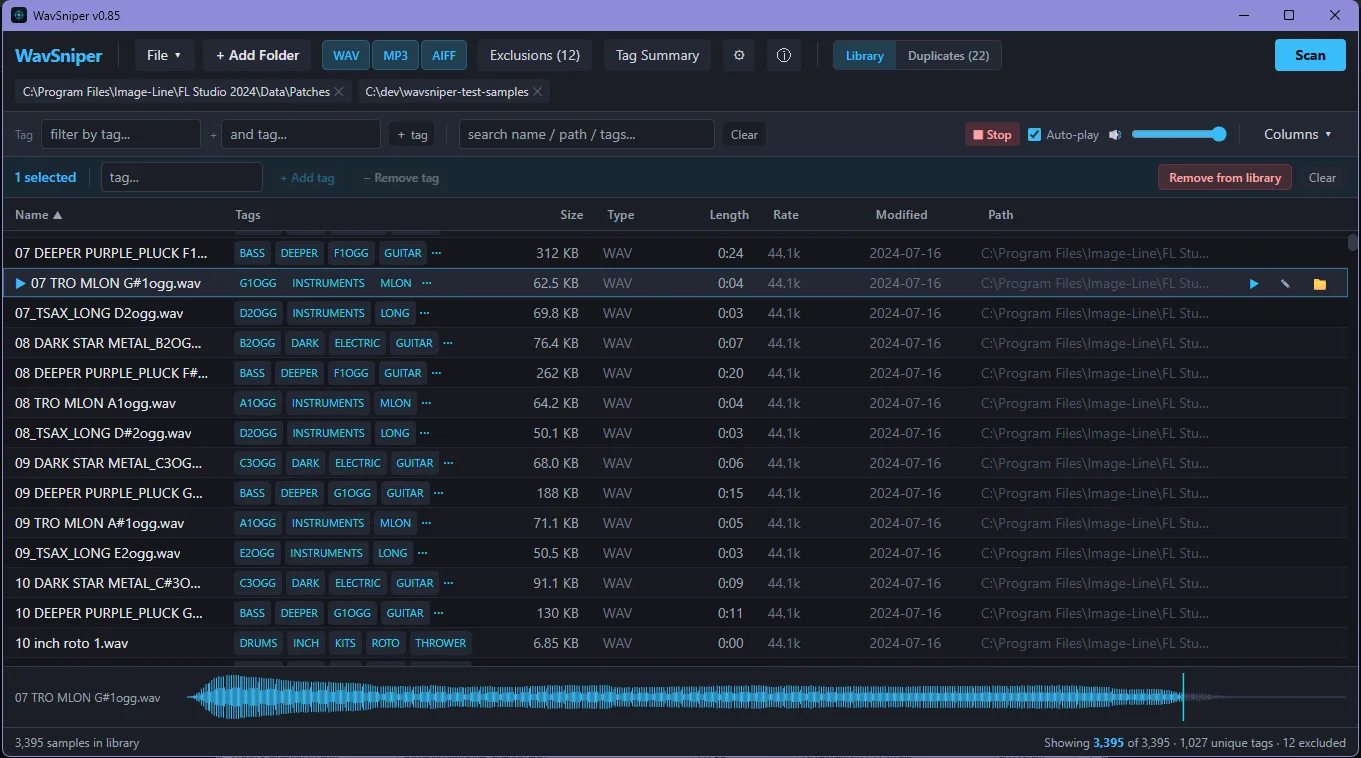
Scan & auto-tag
Point it at your sample folders. A fast scan reads every wav, mp3 and aiff and turns the folder and file names into searchable tags automatically.
Instant search
A virtualized grid handles 100,000+ samples with no lag. Filter by tags plus free text to narrow thousands of sounds to the one you want in seconds.
Audition + waveform
Click to preview instantly. A live waveform draws under the selection with a playhead you can click to scrub. No more guessing from filenames.
Drag into your DAW
Drag a sample, or a whole multi-selection, straight from WavSniper into your DAW or any app. The sound goes where your session needs it.
Duplicate finder
A CRC32 hash of every file surfaces exact duplicates, grouped by wasted space. Keep one, send the rest to the Recycle Bin: recoverable, never a hard delete.
Small & light
A tiny native Windows app instead of a heavy .NET dependency. Your files stay where they are; it only moves one when you ask, and then only to the Recycle Bin.
What's new
- v1.1.0latest
Trial enforcement now also covers drag-to-DAW: once the free 14-day trial ends, your library stays fully browsable, but scanning new folders, saving, and dragging samples out require activation.
- v0.85
First public beta: a recursive scan that auto-tags every wav, mp3 and aiff from your folder and file names, a grid that stays smooth past 100,000 samples, instant click-to-audition with a live waveform, a CRC32 duplicate finder, drag straight into your DAW, a parallel folder scanner, audio transcoding, an in-app update check and the free 14-day trial.
2012 → 2026
A fourteen-year idea, rebuilt for today.
The original WavSniper shipped in 2012. The idea held up; the technology didn't. It's been rebuilt from the ground up: smaller, faster, and packed with the tools producers actually reach for.